

Native English speakers do not combine words randomly, instead, they form natural combinations known as collocations, by bringing certain verbs and nouns together. Verb and noun collocations are commonly encountered in the daily use of English vocabulary. Learning these word structures will help you sound more fluent and native-like when speaking or writing.
In this post, you will learn 10 common verb and noun collocations in English with their meanings, and example sentences that show how they are used in everyday communication.
What Are Verb and Noun Collocations?
A verb and noun collocation is a natural combination of a verb and a noun that commonly appear together in English. These combinations are widely used by native speakers and are often difficult for new learners to grasp without studying them.
For example, English speakers say make a decision, not do a decision. They say pay attention, not give attention. These word combinations are called verb and noun collocations in English. By learning these collocations, you can expand your vocabulary and better understand how certain words naturally work together.
Learning English collocations also helps improve fluency because you begin to think in natural word combinations instead of translating word by word. Many learners understand grammar well but still sound unnatural when they speak because they do not know collocations well enough.
Below, we share 10 common verb and noun collocations used in daily communication in English.
1. make a decision
The collocation make a decision means to choose between different options. It is commonly used when someone must select the best option after thinking about the possibilities. This is one of the most common collocations examples in business, education, and everyday life.
Example sentences with "make a decision":
“She needs to make a decision soon.”
“We made a decision after discussing the problem.”
2. take a break
Take a break means to stop working or studying for a short period of time in order to rest. This verb and noun collocation is commonly used at work, school, or during long tasks.
Example sentences with "take a break":
“Let's take a break after this task.”
“He took a short break during work.”
3. pay attention
The collocation pay attention means to focus carefully on something. It is frequently used in classrooms, meetings, and conversations when someone wants others to concentrate.
Example sentences with "pay attention":
“Please pay attention to the instructions.”
“Students must pay attention during the lecture.”
4. catch a cold
Catch a cold means to become sick with a common cold. This is a very common health-related collocation in English conversation.
Example sentences with "catch a cold":
“He caught a cold last weekend.”
“She caught a cold after traveling.”
5. make progress
Make progress means to improve or move forward toward a goal. It is often used in learning, work projects, and personal development.
Example sentences with "make progress":
“Are you making progress in English?”
“Our team made progress on the project.”
6. give advice
The collocation give advice means to offer suggestions or guidance to someone. This collocation is commonly used when people help others solve problems or make decisions.
Example sentences with "give advice":
“He gave advice about the job interview.”
“My teacher gave useful advice yesterday.”
7. have a conversation
The collocation have a conversation means to talk with someone. It is often used to describe discussions between two or more people.
Example sentences with "have a conversation":
“We had a long conversation yesterday.”
“They had a conversation about work.”
8. make a mistake
Make a mistake means to do something incorrectly or choose the wrong action. This is one of the most common collocations examples in English learning and everyday conversation.
Example sentences with "make a mistake":
“I made a mistake in the report.”
“Everyone makes mistakes while learning.”
9. take responsibility
Take responsibility means to accept that something is your duty or fault. It is frequently used in professional and personal situations.
Example sentences with "take responsibility":
“He took responsibility for his mistakes.”
“Managers must take responsibility for decisions.”
10. reach an agreement
Reach an agreement means that two or more people finally decide on something after discussion or negotiation. It is commonly used in business and legal contexts.
Example sentences with "reach an agreement":
“The companies reached an agreement yesterday.”
“They reached an agreement after negotiations.”
Why You Should Learn Verb and Noun Collocations
Studying collocations in English helps learners speak and write more naturally. Instead of thinking of a translation for each word, you begin to recognize common word combinations used by native speakers on a daily basis.
Going through as many collocation examples as possible also improves reading and listening comprehension because these word combinations appear frequently in real communication, in texts you read and in news you watch. The more verb and noun collocations you know, the easier it becomes to express your ideas clearly and confidently.
By practicing collocations regularly and reviewing them in context, learners can develop a stronger and more natural English vocabulary.
Last Updated: March 12, 2026
English Collocations App
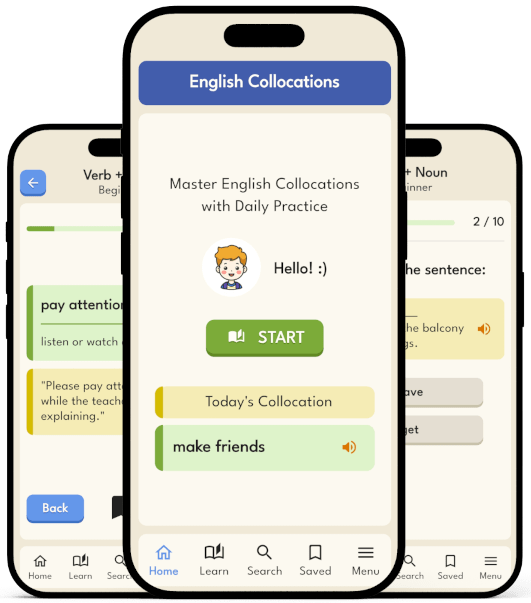
Download Our App to Learn and Practice
English Collocations!
